
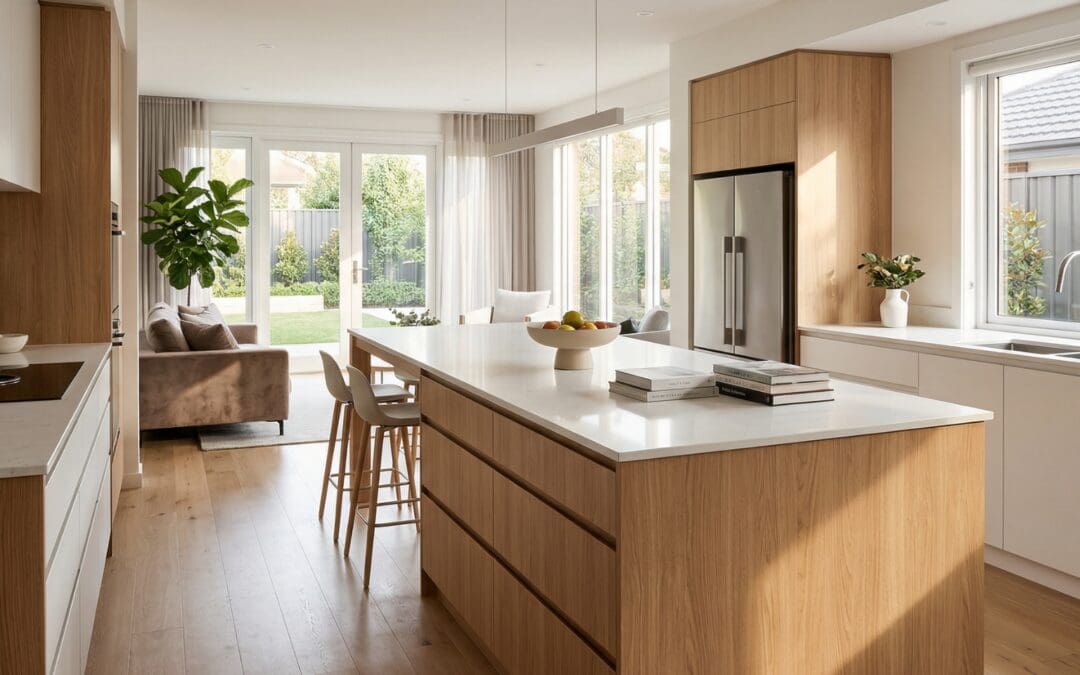
Open plan living is the default in almost every new home built across South West Sydney in the last decade. The kitchen, dining, and living areas merge into one large space. It looks great in the display home. But once a real family moves in, the problems start showing.
The issue is not the open plan concept itself. It is how the kitchen gets placed within it. Most volume-builder kitchens treat the open plan layout as a cost-saving exercise, not a design opportunity. And the result is a kitchen that works against the flow of the home instead of with it.
The Three Layout Mistakes We See Most Often
After more than 40 years building kitchens across the Macarthur region, there are three layout problems that come up again and again in homes built between 2015 and 2023.
The Dead End Peninsula
This is the most common layout in volume-builder homes. A peninsula bench extends from the wall and creates a barrier between the kitchen and the living area. It looks like an island, but it only has access from one side.
The problem is traffic flow. One person cooking at the stove blocks the only path through the kitchen. Kids coming in from the backyard have to walk around the long way. Groceries have to be carried further than they should. The peninsula creates a bottleneck in the room that is supposed to be the most open.
The Overhead Cabinet Wall
Many builder kitchens line one full wall with overhead cabinets from end to end. This provides storage, but it also creates a visual wall in what should be an open space. The overheads block sightlines between the kitchen and living area. They make the kitchen feel closed in, even though there are no doors.
Worse, the top shelves of overhead cabinets are rarely used. Most people cannot reach them without a step stool. That means you have storage you paid for but never actually use, and it is making the room feel smaller.
The Forgotten Work Triangle
The work triangle (the path between the fridge, sink, and cooktop) is the foundation of kitchen layout design. In a well-planned kitchen, these three points form a triangle with each side measuring between 1.2 and 2.7 metres. That spacing keeps movement efficient while you cook.
In many newer estates like Oran Park and Gregory Hills, the builder kitchen places the fridge in a tall pantry unit on one side of the room, the sink along the back wall, and the cooktop on the peninsula. The result is a stretched triangle where you walk three or four metres between each point. That does not sound like much, but multiply it by every meal, every day, and the layout becomes tiring to use.
Why These Mistakes Happen
Volume builders work to a formula. The kitchen is designed to a price point, not a lifestyle. Standard cabinet sizes get dropped into a floor plan. The layout is optimised for construction speed, not daily use. Plumbing and electrical points are placed where they cost the least to install, not where they make the most sense for cooking.
None of this is visible during the buying process. The display home has staged accessories, fresh flowers, and no one actually cooking in it. The real experience only becomes clear once you are living with the kitchen every day.
How to Fix an Open Plan Kitchen That Does Not Work
If your current kitchen suffers from one of these layout problems, there are practical ways to fix it without gutting the entire room.
Convert the Peninsula to an Island
Removing the wall connection on a peninsula bench opens up movement on both sides. This single change improves traffic flow, creates a second entry point into the kitchen, and makes the space feel more connected to the living area.
An island also gives you the option to add seating on the outer edge, turning the bench into a casual dining spot for breakfast and homework. This is one of the most requested changes we see from families in Campbelltown and Camden who are upgrading their builder-grade kitchens.
Replace Overheads With Open Shelving or a Rangehood Feature
Removing a section of overhead cabinets and replacing them with open shelving or a statement rangehood opens the sightline between the kitchen and living room. You lose a small amount of storage, but you gain a room that feels twice as spacious.
The storage can be recovered by adding pull-out pantry units, deeper base cabinets, or a dedicated pantry cupboard elsewhere in the kitchen. Smart storage at waist and eye level is always more useful than dead space above your head.
Tighten the Work Triangle
If your fridge, sink, and cooktop are too spread out, consider relocating one of the three to bring the triangle back into an efficient shape. Moving the fridge closer to the cooking zone is often the simplest fix because it usually only requires a power point relocation, not a plumbing change.
In some cases, moving the sink to an island bench brings it closer to both the cooktop and the fridge, tightening the triangle and improving the prep workflow at the same time.
Planning a New Open Plan Kitchen the Right Way
If you are building new or doing a full kitchen renovation, here is how to avoid these problems from the start.
Start with how your family uses the space. Where do the kids sit? Where do you put groceries when you come in from the car? Do you cook and supervise homework at the same time? These habits should drive the layout, not the other way around.
Next, plan the work triangle before choosing cabinetry. Get the fridge, sink, and cooktop in the right positions first. Everything else, the drawers, the pantry, the overhead storage, builds around those three points.
Then think about sightlines. Standing at the cooktop, can you see the living area? Can you see the back door? In a family home, visibility across the open plan space is not just about aesthetics. It is about keeping an eye on kids, pets, and guests while you cook.
Open Plan Works When the Kitchen Is Designed for It
The open plan concept is not the problem. The problem is kitchens that were designed for closed rooms and dropped into open spaces without adjusting the layout. When the kitchen is built around how the room is actually used, open plan living delivers exactly what it promises: a connected, functional space where the whole family can be together.
If your kitchen layout is working against your home instead of with it, talk to the Cobbitty Grove design team. We will assess your current space, show you where the layout is costing you time and function, and design a kitchen that fits the way your family lives.